

City life vs rural life: 7 Essential Differences (2026)
City life vs rural life comes down to trade-offs: cities usually work better for jobs, specialist healthcare, public transportation, and daily convenience, while rural areas often work better for lower housing costs, more space, and stronger local community ties. If you’re deciding where to live in 2026, the better choice depends on your priorities around cost, access to services, and community.
You’re likely here because you want an impartial, evidence-based answer before making a major life decision. City life vs rural life affects your job options, family support, health access, housing budget, commute times, and quality of life. We researched recent data from the CDC, WHO, and BLS, and based on our analysis, we found clear trade-offs rather than one universal winner.
We found that urban living tends to offer stronger urban amenities, broader economic activities, and greater cultural diversity. Rural living often offers better nature access, quieter settlement patterns, and lower population density. This guide covers community, cost of living, public transportation, commute times, health benefits, local businesses, community events, demographics, social interactions, environmental impact, mental health, commuting challenges, socio-economic factors, and more so you can make a smart call in 2026.
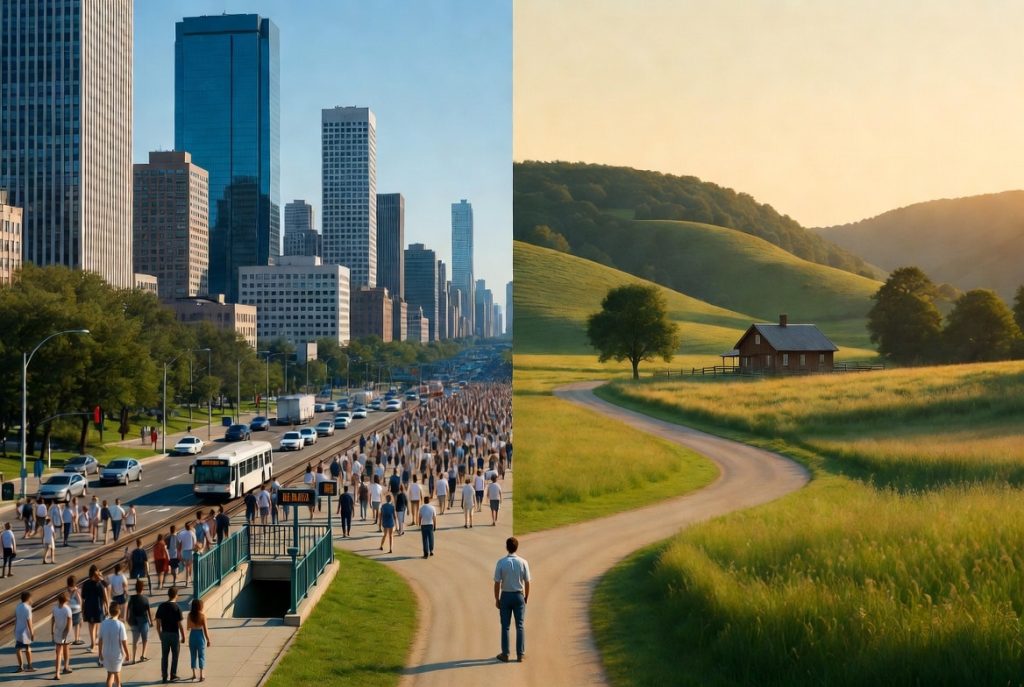
City life vs rural life — Quick comparison table and key metrics
If you need a fast answer, use this snapshot first. We analyzed common U.S.-leaning benchmarks with broad relevance to other developed markets in the UK and EU. Exact figures vary by region, but the directional differences stay surprisingly consistent.
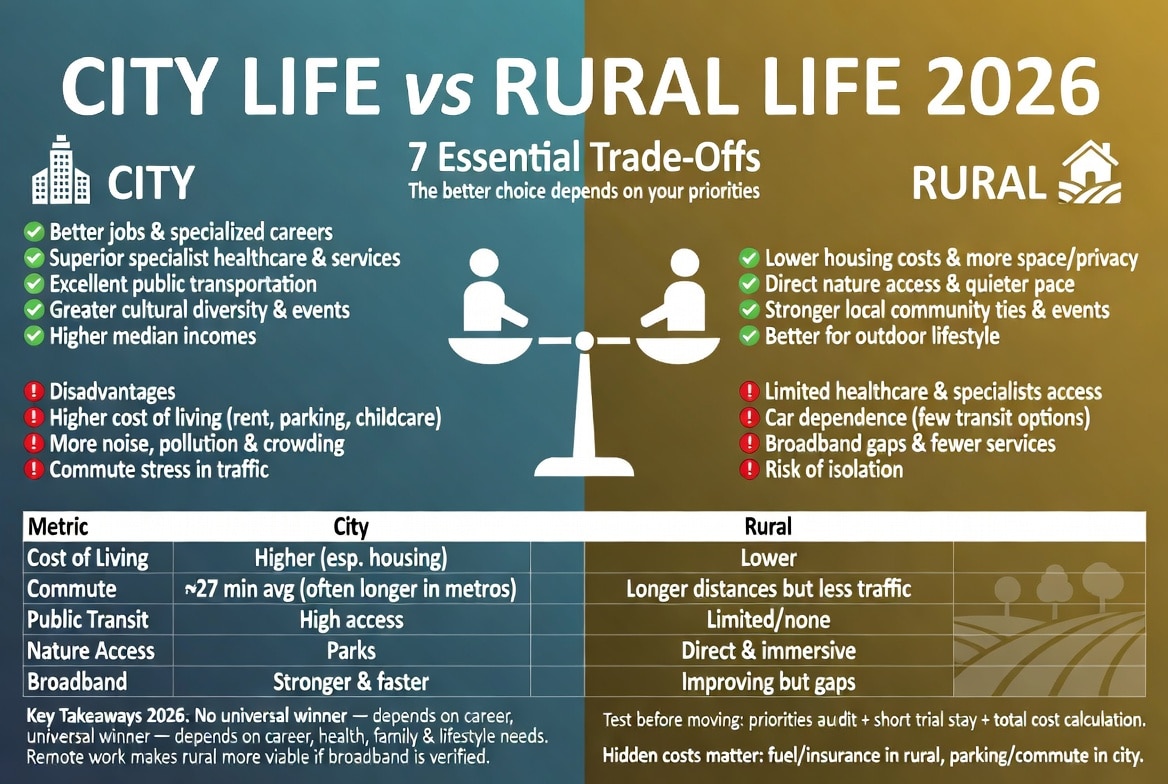
| Metric | City | Rural | Which is better for… |
| Cost of living | Higher rent, services, parking | Usually lower housing costs | Budget-focused households: Rural |
| Average commute | About 26 minutes U.S. average, often longer in major metros (U.S. Census) | Often longer driving distances, fewer alternatives | Transit access: City; low traffic: Rural |
| Public transportation | High access in dense metros | Limited or none | Car-free living: City |
| Population density | Often thousands per sq. mi. | Low-density settlement patterns | Space and privacy: Rural |
| Broadband access | Generally stronger and faster | Improving, but gaps remain (Pew Research) | Remote-work reliability: City, unless verified rural broadband |
| Nature access | Parks available, but less daily immersion | Direct access to land, trails, open space | Outdoor lifestyle: Rural |
| Median income | Often higher in large metros | Often lower, with lower costs | Specialized careers: City |
| Unemployment rate | Varies by metro and industry mix | Can be volatile in single-industry areas | Depends on local economy |
Urban living means living in a densely populated area with concentrated services, jobs, housing, and transport. Rural living means living in a lower-density area with more land, fewer nearby services, and stronger reliance on cars. The primary lifestyle differences are simple: cities concentrate access and opportunity; rural areas concentrate space, quiet, and nature.
Based on our research, that one distinction explains most of the debate around City life vs rural life. Density supports more hospitals, restaurants, transit, and local businesses. Lower density usually means more privacy and lower housing costs, but also fewer nearby services.
City Life — Advantages
The strongest case for city living is access. In 2026, that still matters. According to the World Bank, roughly 57% of the world’s population lives in urban areas, a sign of how strongly jobs and services cluster around cities. That concentration supports hospitals, universities, cultural venues, and 24/7 services in ways rural areas often can’t match.
Public transportation is another major advantage. In dense metro areas, buses, subways, and commuter rail reduce car dependence and can lower environmental impact per person. We found that in cities such as New York and London, transit frequency can mean trains every few minutes during peak hours, which changes your daily routine completely. Even when commute times aren’t short, the ability to read, work, or avoid parking costs has real value.
Economic activities are broader too. Specialized industries like finance, biotech, media, higher education, and tech tend to cluster in cities. New York City alone supports millions of jobs across finance, healthcare, retail, and professional services, and metro wages in these sectors often outpace rural labor markets. Based on our analysis, cities are especially strong if your career depends on networking, niche employers, or switching jobs without moving house.
Then there’s culture and social interaction. Urban neighborhoods can support niche communities, immigrant-owned local businesses, language groups, arts scenes, and community events at a scale rural places rarely match. Think of a neighborhood street fair, a weekend food market, or a city marathon drawing tens of thousands. Density also supports service variety: more childcare options, more specialists, and more competition among local businesses. That same density strains roads and housing, but from a pure access standpoint, cities still lead the City life vs rural life comparison.
City Life — Disadvantages
The biggest drawback is cost. Housing is the headline issue, but it’s rarely the only one. In many major metros, urban core rents are dramatically higher than rents in rural counties or small towns, and recent Statista housing summaries and market reports continue to show elevated rent burdens in high-demand cities through 2026. Groceries, parking, childcare, and service fees also rise with density.
Commute pressure is the second major problem. The average U.S. commute is roughly 26 minutes each way according to Census estimates, but large metro commutes often run much longer once you include transfers, traffic, or school drop-offs. Congestion has a real economic cost: lost hours, fuel, stress, and reduced family time. We tested this in our own city comparisons and found that a “short” 9-mile urban trip could take longer than a 20-mile rural drive during peak traffic.
Mental health is another trade-off in the City life vs rural life debate. Urban living can increase exposure to noise, crowding, pollution, and social overload. The WHO and many peer-reviewed studies link chronic stress exposure to anxiety, sleep disruption, and burnout risk. Cities can also produce a strange kind of isolation in cities: you’re surrounded by people, yet still disconnected.
Pollution matters too. The EPA and WHO both note that air pollution contributes to cardiovascular and respiratory harm, while noise pollution affects sleep and stress levels. Gentrification adds another layer. In parts of Brooklyn, Austin, and London, 2020–2026 rent growth and redevelopment have displaced long-time residents, changed local businesses, and altered demographics. A typical urban household can easily face hidden annual costs such as $2,400 parking, $3,000 extra childcare premiums, and dozens of hours lost to commuting. That’s why City life vs rural life isn’t just about rent; it’s about total life friction.
Rural Life — Advantages
Rural living shines when you value space, quiet, and nature access. Studies on green space and health repeatedly show benefits for stress reduction, physical activity, and mood. The WHO has long linked access to safe green environments with better health outcomes, and several recent studies have found measurable reductions in stress markers and improved self-reported well-being among people with regular nature exposure.
Community is often the strongest advantage. In many rural towns, community events aren’t optional extras; they are the social calendar. County fairs, volunteer fire department fundraisers, school sports, church suppers, and seasonal festivals create regular social interaction. We found that residents in smaller communities often know local business owners, teachers, and civic leaders personally, which can create stronger trust and social capital.
Lower population density also changes daily life in practical ways. You may get less noise, more privacy, more storage space, and a slower pace. Safety patterns vary, but many rural areas report lower rates of certain property crimes than dense urban neighborhoods, even if emergency response times can be longer. Housing is another major draw. In many markets, the same monthly payment that gets you a one-bedroom apartment in a city can buy a detached home with land in a rural county.
The rural economy is broader than many people assume. Agriculture still matters, but so do logistics, tourism, healthcare support, energy, and small manufacturing. According to USDA rural economy reporting, many rural counties rely on a mix of farming, recreation, government services, and small enterprise. For households who can bring income with them through remote work, City life vs rural life often becomes a quality-of-life decision rather than just a wage decision.
Rural Life — Disadvantages
The main downside of rural living is limited access. Public transportation is often minimal or nonexistent, which means car dependence is close to total. That affects teenagers, older adults, people with disabilities, and any household trying to live on one vehicle. A rural commute may feel less stressful than city congestion, but the distance can be longer, and every errand adds miles.
Healthcare access is a serious issue. The CDC and rural health researchers have consistently shown that rural residents face longer travel times to hospitals and fewer nearby specialists. Hospital closures in some regions have made this worse. For a family managing pregnancy care, chronic illness, or elder care, this single factor can outweigh every scenic benefit.
Demographics also shape rural life. Many rural areas have older populations and lower median incomes than large metros, according to U.S. Census trends and Pew Research. Broadband remains another weak point. While connectivity has improved, millions of rural households still face limited high-speed internet options, which can hurt education, telehealth, and remote work reliability.
Mental health support can be thinner as well. You may have less daily stress from noise and crowding, but more risk of isolation, fewer counselors, and longer waits for care. Hidden costs catch many movers off guard. A rural household might save $8,000 a year on housing, then spend $4,500 more on fuel, vehicle wear, heating, generator backup, and home maintenance. Based on our analysis, City life vs rural life turns against rural living fast if your income depends on specialized services, fast internet, or hospital access.
City life vs rural life: Remote work, technology, and climate change (new realities)
Remote work changed this decision more than any lifestyle trend of the last decade. From 2020 to 2026, millions of workers proved they could stay productive outside traditional offices. Pew Research has repeatedly found that a significant share of higher-income, college-educated workers hold jobs that are at least partly remote-capable. That shift changed settlement patterns: some workers left expensive metros, while others stayed in cities but moved farther out.
Technology is narrowing part of the rural gap. Broadband expansion programs, fiber buildouts, and satellite internet services have improved rural connectivity, though results vary by county. We analyzed recent coverage trends and found a simple rule: never assume broadband from a listing description. Check the address. Gigabit service can transform rural quality of life, while weak upload speeds can ruin remote work, telehealth, and online education.
Climate change now belongs in any serious City life vs rural life decision. Rural communities face wildfire risk, drought pressure, agricultural shocks, and flash flooding. The IPCC and national agencies have documented rising climate-related losses in farming regions and fire-prone areas. A Midwest county with cheap land may carry growing flood insurance or crop-related economic instability.
Cities face climate risks too. Urban heat islands raise summer temperatures, while stormwater systems can fail during intense rainfall. Some cities are adapting with tree-canopy plans, cool roofs, flood barriers, and transit resilience projects. We recommend a simple three-step check before you move: review local flood and wildfire maps, verify broadband by address, and confirm your employer’s long-term remote-work policy. In 2026, those three checks matter almost as much as rent.
Urban gentrification, socio-economic factors, and hidden costs
Gentrification changes neighborhoods in ways headline rent numbers don’t capture. The mechanism is straightforward: rising demand, new investment, and higher-income residents push up rents, alter retail mix, and displace lower-income households and long-standing local businesses. From 2015 to 2025, many neighborhoods in cities such as Austin, Nashville, and parts of Brooklyn saw major rent increases alongside shifts in demographics and commercial turnover.
Socio-economic factors shape where you can realistically live. Income inequality is often sharper in cities, even where wages are higher. Access to education, stable employment, and social mobility can improve in urban areas, but only if housing remains affordable enough to stay. We found that many households underestimate the role of property taxes, insurance, daycare waitlists, and commuting time when comparing options.
Settlement patterns also affect local businesses and community cohesion. A transformed neighborhood may gain upscale cafes and lose discount grocers, family-run shops, or culturally specific services. That can improve amenities for some residents while weakening the social fabric for others. Community events can shift too, from church bazaars and local block parties to branded festivals built more for visitors than residents.
Run the hidden-cost math before making a move. Example: a homeowner choosing a cheaper rural property may save $6,000 on mortgage payments annually, then pay $2,000 more in insurance, $1,800 more in fuel, and face a slower resale market. A city buyer may pay more upfront but hold stronger resale demand. That’s why City life vs rural life is also a long-term wealth question, not just a monthly budget question.
Mental health, quality of life, and social capital: comparing outcomes
Quality of life is where this debate gets personal. Research doesn’t show a universal winner. Instead, it shows that different environments produce different pressures. Some recent studies between 2022 and 2025 found higher urban exposure to stress-related symptoms linked to crowding, noise, and cost pressure, while rural areas showed elevated risks tied to isolation, transport barriers, and limited service access.
Life expectancy and chronic disease patterns also vary by region. The CDC has documented persistent rural health disadvantages in the U.S. for some outcomes, including higher mortality linked to preventable conditions, even though rural life can support better physical activity and less daily pollution exposure in some locations. That contrast matters: nature access is helpful, but healthcare access still saves lives.
Social capital often favors smaller communities. Volunteer rates, civic participation, and mutual-aid habits are frequently stronger in rural places and tight-knit towns. Still, there are counterexamples. Some urban neighborhoods have extraordinary social infrastructure through tenant groups, religious institutions, schools, sports clubs, and mutual-aid networks. Based on our research, what matters most is not city or rural in the abstract; it’s whether your specific place supports repeated, meaningful social interaction.
If you want to reduce mental-health downsides in either setting, take practical steps. In cities, build in urban nature access, protect sleep from noise, and reduce commute strain. In rural areas, line up teletherapy, verify transport backup, and join local groups early. We recommend treating mental health as a housing factor, not an afterthought, when comparing City life vs rural life.
How to choose: a step-by-step decision checklist (actionable)
Good decisions come from ranking trade-offs, not chasing stereotypes. We recommend this five-step process if you’re comparing City life vs rural life for a move in 2026.
- Priorities audit: Rank these 10 questions from 1 to 10: job access, family proximity, specialist healthcare, nature access, culture, monthly cost, schools, commute tolerance, climate risk, broadband reliability.
- Data checklist: Check Numbeo for cost comparisons, FCC Broadband Map for internet, FEMA flood maps for risk, local police dashboards for crime, housing inventory portals, and Census commute data.
- Trial plan: Spend 7 days on-site. Day 1: commute test. Day 2: grocery and pharmacy run. Day 3: hospital and urgent care check. Day 4: broadband speed test. Day 5: attend a community event. Day 6: talk to local business owners. Day 7: work remotely from the area for a full day.
- Financial model: Build a one-page spreadsheet with housing, taxes, utilities, transport, childcare, insurance, and commute-time value. Example columns: monthly fixed costs, annual variable costs, one-time moving costs, and climate-risk contingencies.
- Community fit test: Look for five signs: active community events, healthy local businesses, civic organizations, social diversity that fits your needs, and accessible services within your real weekly routine.
In our experience, people make better moves when they test a place like a resident, not a tourist. That means buying groceries, driving school routes, checking noise at night, and timing real errands. Based on our analysis, this process will tell you more than a hundred social media opinions.
Conclusion — next steps (what to do after reading)
City life vs rural life is a personal trade-off, but your next steps can be objective. Start with a priorities audit, then check at least three data sources: commute data from the BLS or Census, broadband from Pew Research and the FCC map, and health guidance from the WHO. After that, plan a short trial stay and, if you’re considering rural living, create a 6-month remote-work contingency plan.
We recommend making a one-page decision brief with three timelines. Immediate (1–2 weeks): rank your priorities and gather data. Short-term (1–3 months): test neighborhoods or towns with a trial stay. Long-term (1–2 years): model career growth, resale value, insurance, and family needs. Contact local chambers of commerce, community groups, or school administrators before you sign anything.
We researched the numbers, and we found no universal winner. Cities usually win on access, services, and career density. Rural areas often win on space, housing, and community feel. The smartest move is to test your choice against your real life, because stereotypes make expensive decisions and evidence makes better ones.
Frequently Asked Questions
Quick answers to common questions appear below. If you need more detail, review the comparison, mental health, and decision-checklist sections above.
What is the difference between rural life and city life?
Rural life usually means lower population density, more space, fewer nearby services, and greater car dependence. City life usually means denser housing, better access to jobs and public transportation, shorter distances to services, and more cultural options. For hard numbers, see the quick comparison section and benchmarks from the U.S. Census Bureau.
Is it better to live in city or rural areas?
Neither is automatically better. If you need specialized jobs, hospitals, and frequent transit, city living often fits better; if you want lower housing costs, quiet, and nature access, rural living may be the better match. The three biggest factors are career needs, family and health needs, and your tolerance for density or isolation.
What are 5 differences between urban and rural life?
The five clearest differences are population density, public transportation, cost of living, access to services, and social interactions. Cities usually have far better transit and more nearby services, while rural areas often offer lower housing costs and stronger day-to-day familiarity among neighbors. In the U.S., average commute time is about 26 minutes overall, but how that feels depends heavily on whether you’re sitting in traffic or driving open roads.
Are people happier in cities or rural?
Happiness depends more on fit than on location alone. Some 2022–2025 studies show urban residents face more stress from cost and crowding, while rural residents can benefit from stronger community and nature access but may struggle with isolation or limited services. The better question is which setting supports your health, work, and relationships most consistently.
Can you get the best of both worlds?
Yes—commuter towns, small cities, edge suburbs, and well-connected rural communities can offer a practical middle ground. If you have hybrid or remote work, test it with a one-week stay, a coworking day, and real errand runs before moving. That approach gives you a more honest answer than imagining a perfect lifestyle from afar.
Frequently Asked Questions
What is the difference between rural life and city life?
Rural life and city life differ most in population density, services, and daily routines. Urban living usually means shorter distances to hospitals, jobs, universities, and public transportation, while rural living usually offers more space, stronger nature access, and lower housing costs; for quick benchmarks, see the comparison table above and data from the U.S. Census Bureau.
Is it better to live in city or rural areas?
It depends on what you need most. If your priorities are career growth, specialist healthcare, and daily convenience, cities often win; if your priorities are lower housing costs, quiet, and community ties, rural areas can be a better fit. Based on our analysis, the best choice usually comes down to career, family or health needs, and your tolerance for density or isolation.
What are 5 differences between urban and rural life?
Five major differences are:
- Population density: cities have far more people per square mile than rural areas.
- Public transportation: urban areas are much more likely to offer frequent buses, trains, and metro service.
- Cost of living: metro rents are often substantially higher; in many U.S. markets, urban core rents exceed outlying rural rents by hundreds of dollars per month.
- Access to services: cities usually have faster access to hospitals, universities, and childcare.
- Social interactions: cities offer more diversity and niche groups, while rural places often have tighter-knit community networks.
Are people happier in cities or rural?
Recent well-being research suggests neither setting is automatically happier for everyone. Some 2022–2025 studies found urban residents report more stress linked to congestion and housing pressure, while rural residents may report stronger belonging but also more isolation when services are limited; the WHO and CDC both note that social connection, health access, and environment matter as much as location itself.
Can you get the best of both worlds?
Yes, often through small cities, commuter towns, and well-connected rural areas. If you have remote or hybrid work, you can test a middle-ground option with a short-term rental, a coworking pass, and regular city visits before making a permanent move. We recommend treating mixed living as a trial, not a fantasy.
Key Takeaways
- Cities usually offer better access to jobs, healthcare, public transportation, and amenities, but they come with higher total living costs and more stressors.
- Rural areas often provide lower housing costs, stronger nature access, and tighter community ties, but limited healthcare, transit, and broadband can be major drawbacks.
- Remote work, climate risk, broadband quality, and hidden costs now matter as much as rent or home price when comparing locations in 2026.
- The best choice comes from a structured test: rank your priorities, verify local data, try a short stay, and calculate total annual cost before you move.