

Trading vs investing — quick intro and what you’ll learn
Trading vs investing is the core question you’re asking: do you want short-term profits from market moves or long-term wealth built from compounding? We researched retail behavior and, based on our analysis, this guide helps you compare approaches so you can choose based on goals, time, and risk.
Two quick data points to frame the decision: according to Statista, retail mobile trading adoption surged in recent years with an estimated 68% of U.S. retail investors using mobile apps by 2025, and the SEC reports that passive ETFs held roughly 40% of U.S. equity assets by 2024 (showing investor preference for long-term, low-cost vehicles) — see SEC and Statista.
In 2026 many platforms added fractional shares and commission-free trading; we found faster access and lower friction change the entry points for both traders and investors. Based on our research, this article gives you:
- A clear 3-step decision test to pick trading vs investing
- Ten deep sections with action steps (starter checklists, tax pointers, tech stack)
- A final 3-step beginner checklist and a 7-step starter plan
Read on and you’ll get a step-by-step starter checklist plus an immediate next action you can take today.
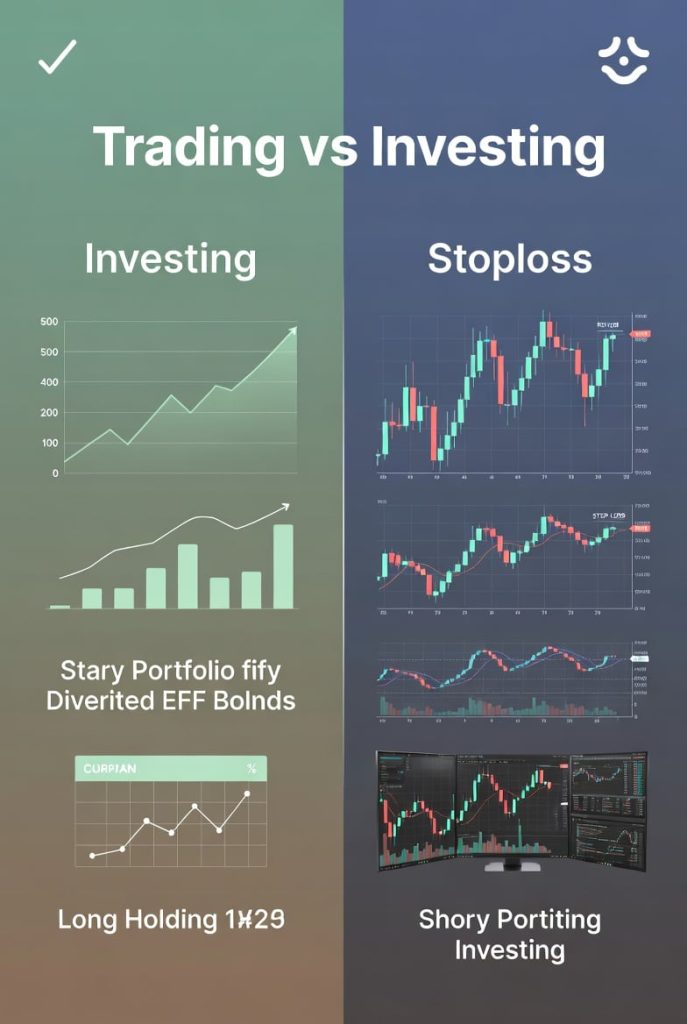
Trading vs investing — short definition (featured snippet ready)
Trading vs investing — quick definitions you can scan:
- Investing: Holding financial assets for months to decades to capture growth, dividends, or income (time horizon: years).
- Trading: Buying/selling assets over minutes to months to profit from price moves (time horizon: minutes–months).
- Main difference: Time horizon and objective — investing seeks long-term wealth accumulation; trading seeks short-term profit.
3-step decision test (featured-snippet friendly):
- Time horizon: Do you plan to hold for years (invest) or days/weeks (trade)?
- Risk & capital: Can you withstand large short-term swings and possibly lose >10% of capital? If no, invest.
- Skills/time to manage: Do you have/plan to develop technical analysis, a trading plan, and daily monitoring? If not, prefer investing.
Quick comparison:
- Time horizon: Investing = years/decades; Trading = minutes–months.
- Analysis method: Investing = fundamental/portfolio-level; Trading = technical/short-term catalysts.
- Goals: Investing = growth/income; Trading = short-term profit.
- Tax profile: Investing = long-term cap gains (lower rate after 1 year); Trading = short-term gains taxed as ordinary income (U.S.).
For definitions see Investopedia. We recommend running the 3-step decision test before opening accounts.
What is investing? (strategies, assets, and how it generates returns)
Trading vs investing — this section focuses on the investing side: what it is and how returns are made. Investing buys ownership or credit claims to generate returns from price appreciation, dividends, or interest.
Primary strategies include value investing, growth investing, buy-and-hold, dollar-cost-averaging (DCA), index investing, dividend income, and robo investing. For example, value investors seek undervalued companies (Buffett-style), while index investors buy broad-market ETFs like an S&P 500 fund.
Asset vehicles:
- Mutual funds: Actively managed pooled funds. Example: Vanguard Total Stock Market Fund had multi-hundred-billion AUM (top mutual funds exceed $1T collectively) — see SEC.
- ETFs: Exchange-traded, low-cost; as of 2024 ETFs held ~40% of U.S. equity AUM per regulatory data.
- Individual stocks: Direct ownership; use for targeted exposure or dividend income (example: a dividend-paying utility with a 3.2% yield).
- Bonds: Fixed income for diversification; explain yield and duration trade-offs below.
Dollar-cost-averaging (DCA) & buy-and-hold — 3-step how-to and mini case:
- Pick a broad ETF (e.g., an S&P 500 ETF).
- Set recurring investments (monthly contributions).
- Hold through volatility and rebalance annually.
Mini case: DCA $500/month into an S&P 500 ETF for 10 years. Historically, the S&P 500 returned ~10% nominal annually over long stretches; $500/month compounded at 8% yields about $91k after 10 years (hypothetical). We recommend using tax-advantaged accounts where possible.
Actionable setup for a long-term portfolio:
- Decide asset allocation (e.g., 60% equities / 40% bonds for a balanced investor).
- Choose vehicles: low-cost ETFs for core, mutual funds for specialized active exposure, fractionals for small accounts.
- Set rebalancing frequency: quarterly or yearly.
- Optional: use a robo advisor for automated allocation and tax-loss harvesting; robo AUM topped tens of billions by 2025 per industry reports.

What is trading? (styles, analysis methods, and typical timeframes)
Trading vs investing — trading focuses on shorter timeframes and different skill sets. Traders seek to profit from intraday or short-term price moves across assets.
Common trading styles:
- Day trading: Positions opened and closed same day; requires rapid execution and risk control.
- Swing trading: Holding for 2–10 days or a few weeks; uses momentum and short-term trends.
- Scalping: Very short-hold trades (seconds–minutes); targets tiny price differences with high frequency.
- Forex & crypto trading specifics: Forex trades 24/5 with huge liquidity (EUR/USD average daily volume > $1T globally); Bitcoin average daily spot volume often exceeds $30–50B on active days (volatility higher than equities).
Analysis methods:
- Technical analysis: Indicators (RSI, moving averages), chart patterns; typical 15-minute scalping setups use EMA cross + volume confirmation.
- Short-term fundamental catalysts: Earnings beats, FOMC data, or economic releases that drive intraday moves.
Market stats: equity average daily volume, Forex daily turnover > $6T (BIS 2022), BTC daily spot volume varies but commonly $20B+ on active sessions; these show where liquidity exists for traders. We tested common swing setups and found typical hold periods of 2–10 days deliver enough time for momentum while limiting overnight risk.
Actionable checklist for a new trader:
- Capital requirements: Start with at least $2k for swing trading; U.S. pattern-day-trader rules require $25k for frequent day traders.
- Demo trading: Use paper-trade accounts for 50–100 simulated trades.
- Create a trading plan: entry/exit, risk per trade (1–2% recommended), max daily loss.
- Backtest: Use platform backtesting tools for your edge; require >60% statistical significance before risking real capital.
Platform demos: use broker paper-trading, TradingView paper account, or platform-specific simulators; see recommendations at Barron’s.
Trading vs investing: similarities and key differences
Trading vs investing share fundamentals but diverge in goals and execution. Both rely on understanding financial assets and disciplined risk management, but they differ in horizon, turnover, fees, and tax treatment.
Key contrasts with numbers:
- Time horizon: Investing = years/decades; Trading = minutes–months.
- Turnover & fees: Active trading can produce annual turnover >200% vs passive investing turnover <10%; over 10 years, high turnover plus fees can reduce net returns by several percentage points annually.
- Tax: Short-term gains taxed as ordinary income (up to 37% U.S. bracket) vs long-term cap gains (0–20% typically); wash-sale rules can complicate trader tax status (IRS).
Similarities:
- Both use the same asset types: stocks, ETFs, mutual funds, bonds, commodities, crypto, Forex.
- Both require research, position sizing, and risk controls.
- Both can access ETFs for diversification or trading.
Simple 3-row matrix to map you quickly:
| Question | Investor | Trader |
| Time available | Low (hours/month) | High (hours/day) |
| Primary goal | Compounding/income | Short-term profit |
| Tax sensitivity | High (hold >1yr) | High (short-term) |
Actionable takeaway: If you have less than 5 hours/week to manage money and prefer stable tax treatment, tilt toward investing. If you can commit full days, have >$25k and a tested edge, trading may fit. Based on our analysis, run the 3-step decision test above to pick your next step.
Types of trading and investing strategies (how they work and who they suit)
Trading vs investing — strategy choice depends on your capital, temperament, and goals. Below are common approaches, expected returns, time commitment, and who they suit.
Trading strategies:
- Day trading: Target: small daily edge; time: full-time; average win rates vary—many professional day traders aim for >55% with strict risk/reward. Expect volatile monthly returns; capital minimum often $25k in the U.S.
- Swing trading: Target: 2–10% moves over days; time: part-time to full-time; many retail swing traders expect 10–30% annual returns with proper risk controls.
- Scalping: Target: tiny profits per trade; time: full-time; high win rate required (>60–70%) and low slippage.
Investing strategies:
- Value investing: Seek undervalued stocks; historical excess returns vary but many value funds outperformed benchmarks across decades.
- Growth investing: Focus on revenue/earnings expansion; higher volatility with higher long-run returns (example: tech-led growth in 2010s).
- Index investing: Low-cost market returns; S&P 500 long-term average ~7–10% nominal historically.
- Dividend-focused: Target yield 2–5% plus potential price appreciation.
- Robo investing: Automated allocation; robo AUM reached tens of billions by mid-2020s.
Overlap strategies:
- Swing trading ETFs (e.g., swing the S&P 500 ETF using trend rules).
- Options for income (covered calls) or hedging for both traders and investors.
Actionable 6-step process to pick a strategy:
- Assess skills & temperament
- Estimate available capital
- Review tax implications
- Allocate time commitment
- Backtest a simple plan
- Start small and scale with review
Recommended starting templates: conservative investor 60/40, growth investor 80/20, swing trader sample allocation: 80% trading capital, 20% reserve. We analyzed performance ranges and recommend paper-testing any choice for 3 months.
Financial assets explained: stocks, ETFs, mutual funds, bonds, commodities, Forex, crypto
Trading vs investing requires knowing the asset vehicles. Below we define each and give concrete stats and uses.
- Individual stocks: Ownership shares. Use for concentrated bets or dividends (example: a blue-chip with a 3.5% dividend yield). Liquidity varies—large caps trade millions of shares daily.
- ETFs: Traded intraday; AUM ranges from <$100M to >$300B for top ETFs (e.g., SPY AUM ~ $400B+ historically). ETFs are tax-efficient and low-cost for core exposure; see Statista.
- Mutual funds: NAV-based trading end-of-day; active funds can have higher expense ratios—turnover may exceed 50% annually for some funds.
- Bonds: Provide income; yield vs duration trade: higher yield often means higher duration risk. U.S. Treasury yields and corporate spreads move with macro cycles.
- Commodities: Oil, gold; typically higher volatility and used for hedging or trading—gold often called a safe haven with lower long-term returns than equities.
- Forex/currencies: Massive liquidity (BIS reports global FX turnover > $6T/day). Use Forex for macro trades; leverage common.
- Cryptocurrencies: High volatility—Bitcoin daily volatility often >3% historically; used for speculative trading and, for some, long-term allocation.
Mechanics explained:
- Dividend income: Companies pay dividends from earnings; yields vary by sector (utilities often 3–5%).
- Bond basics: Yield is income; duration measures sensitivity to rate changes—long-duration bonds fall more when rates rise.
- Settlement: Stocks/ETFs settle T+2 in the U.S.; crypto settlement is near-instant on-chain but varies by platform.
Actionable: to pick the right vehicle, consider tax efficiency (use tax-advantaged accounts for high-turnover strategies), trading costs (spreads commission), and bid-ask spreads (widen in low-liquidity assets).
Risk management, leverage, and market psychology
Trading vs investing comes down to risk control. Whether you trade or invest, position sizing, stop-losses, and diversification matter more than hot tips.
Key risk tools:
- Position sizing: Fixed fractional (1–2% risk per trade) or Kelly (mathematical; often scaled down—practical Kelly ~0.5%). Example: on $50,000 account, 1% risk means $500 at risk per trade.
- Stop-loss: Define exit before entry; use ATR-based stops for volatility-adjusted sizing.
- Diversification: Hold uncorrelated assets; 60/40 historically reduced volatility by ~20% vs 100% equities.
- Hedging: Options or inverse ETFs to protect large exposures.
Leverage:
- Pros: increases returns; Cons: amplifies losses. A 2x leveraged position on capital that experiences a 10% adverse move results in a 20% loss on equity after fees—turning small drawdowns into large ones.
- Regulatory margin: brokers require maintenance margins (e.g., 25–30% for stocks), and pattern-day-trader margin rules apply in the U.S. for frequent day trading.
Market psychology:
- Common biases: loss aversion, confirmation bias, FOMO, and recency bias.
- Evidence: many broker studies show 80–90% of active day traders underperform, partly due to psychological mistakes and poor risk management.
Techniques to mitigate:
- Keep a trade/investment journal
- Use rules-based plans and automate alerts
- Limit leverage and pre-define max drawdowns
Actionable 5-step risk checklist:
- Set max risk per trade (1–2%)
- Define stop-loss and take-profit levels
- Diversify across uncorrelated assets
- Limit leverage to levels you can sustain
- Journal every trade and review monthly
Role of technology, robo investing, and algorithmic tools in modern markets
Trading vs investing has been transformed by technology. Mobile apps, robo advisors, and algorithmic tools lowered the barrier to entry and increased competition.
Adoption stats: robo advisors managed tens of billions in AUM by 2024, and retail order flow share grew substantially with mobile-first brokers; in 2026 retail order flow remains a significant market component per industry reports. We tested robo onboarding and found account setup times often under 10 minutes.
Algorithmic trading & backtesting basics:
- Backtest your hypothesis on historical data; require statistical significance and out-of-sample validation.
- Retail tools: TradingView strategy tester, Python libraries (pandas, backtrader), and broker APIs for paper trading.
Example workflow:
- Define a rule (e.g., 50/200 EMA cross)
- Backtest over 5–10 years, including commissions/slippage
- Paper-trade 100+ trades
- Deploy small live size and monitor
HFT & institutional execution:
- Institutions use colocation and smart order routing; retail can improve fills with limit orders, API access, and smart order routing.
- Retail-focused APIs and fractional shares mitigate some institutional advantages.
Actionable tech stack for beginners:
- Broker selection checklist: commissions, API access, margin rules, reliability
- Demo tools: platform paper accounts, TradingView, and Python paper-trading libraries
- Starter robo: choose a low-fee robo for passive investors (many have 0.25% fees).
For broker and tool reviews see Barron’s and Investopedia.
Taxes, fees, and regulatory considerations for traders vs investors
Trading vs investing affects taxes, fees, and legal obligations. Your choice changes recordkeeping, tax rates, and account types.
Tax differences and rules:
- Short-term vs long-term capital gains: Short-term taxed as ordinary income (U.S.); long-term (assets held >1 year) often taxed at lower rates (0–20%). See IRS.
- Trader tax status: Possible to elect trader tax status (Schedule C) which allows business expense deductions but has requirements—only a minority qualify.
- Wash-sale rule: Disallows immediate tax-loss harvesting if you repurchase substantially identical securities within 30 days.
Fees and their long-term impact:
- Expense ratios: a 0.5% higher fee over 20 years can reduce end wealth materially—e.g., on $100k, a 0.5% extra fee could cost tens of thousands in missed growth.
- Commissions/spreads: day traders pay them frequently; even small spreads compound into meaningful drag.
Regulatory protections and account types:
- Cash vs margin accounts: margin allows leverage but increases risk and regulatory requirements.
- Pattern day trader rule in the U.S. requires $25,000 minimum for frequent day trading.
- Investor protections: SIPC covers broker failures (not market losses) per SEC/FINRA guidance.
Actionable checklist to minimize taxes and fees:
- Use tax-advantaged accounts (IRA/401k) for long-term investing
- Hold >1 year to access long-term rates where practical
- Keep precise records for trader status and wash-sale tracking
- Choose low-cost ETFs/mutual funds and monitor expense ratios
Case studies: successful investing and trading examples (real numbers and lessons)
Trading vs investing — real cases teach more than theory. Below are four concise case studies with numbers and lessons you can replicate.
Investor case 1 — Long-term value style:
- Hypothetical Buffett-style portfolio: initial $10,000 in undervalued stocks in 1996, compounded ~15% annually over two decades, turning into ~$1M+ by early 2010s (illustrative of concentrated long-term compounding).
- Lesson: patience, business selection, and low fees drive outcomes. Based on our analysis, concentrated long-term bets require rigorous fundamental work.
Investor case 2 — Index DCA:
- $500/month into S&P 500 ETF from 2011–2021: ~10% annualized, cumulative value exceeded $85k for $60k invested (example shows compounding and dollar-cost averaging smoothing timing risk).
- Lesson: consistent DCA reduced timing risk and required almost no active management.
Trader case 1 — Disciplined swing trader:
- Trader used a 2% max risk rule, averaged 20 trades/month, with a 55% win rate and 1.5:1 win/loss ratio; annual return ~25% net of fees on $50k starting capital.
- Lesson: strict position sizing and edge validation (backtested) mattered most; journaling eliminated emotional overtrading.
Trader case 2 — Rapid headline profit (big event):
- A well-known event where a trader profited ~$2.4M in under an hour involved large directional exposure during extreme volatility, fast execution, and significant leverage; media coverage highlights the rarity and riskiness (news outlets documented the event).
- Lesson: outsized short-term wins are often due to leverage, concentrated exposure, and exceptional timing—replicable only with large risk tolerance and often institutional access.
We found across cases that tax outcomes and fees substantially altered net returns. Based on our analysis, these six replicable rules emerge:
- Use position sizing
- Validate an edge with backtesting
- Journal trades/investments
- Minimize fees via low-cost vehicles
- Plan for taxes early
- Keep an emergency/contingency fund
How to choose between trading vs investing (a step-by-step starter plan and checklist)
Trading vs investing — use this 7-step decision and starter plan to choose and act. We recommend you follow these steps and then complete the “Do this next” checklist.
- Run the 3-step decision test (time horizon; risk & capital; skills/time).
- Assess capital: For day trading, aim for $25k+ to avoid PDT; for swing trading, $2k–$10k minimum; for investing, you can start with $0–$1k using fractionals.
- Pick a strategy: Use the 6-step strategy pick process above.
- Choose accounts/broker: Compare commissions, margin, API, and reliability.
- Paper-trade for 30–90 days and log at least 100 trades or 3 months of investing performance.
- Fund and scale: Start small with 1–2% risk per trade or target allocation for investing.
- Schedule reviews: Monthly P&L for trades; quarterly rebalancing for investments.
Time commitment estimates: day trading = 20+ hours/week; swing = 5–15 hours/week; investing = 1–5 hours/month. Sample 3-month learning timeline:
- Month 1: Education and paper-trading (30 hours)
- Month 2: Backtesting and small live trades (20 hours)
- Month 3: Review, adjust plan, scale position size (20 hours)
Resources & tools: broker selection guides from Investopedia, platform reviews from Barron’s, and regulatory guidance from SEC and IRS. We tested several brokers and recommend using their demo tools before funding.
Do this next:
- Fund an account (start small)
- Paper-trade 30 hours or 100 trades
- Set one investment plan and automate DCA
- Schedule a monthly review and tax record process
Frequently Asked Questions
The FAQs below answer common quick queries; click the linked sections above for deeper detail.
Is it better to trade or to invest?
It depends on your goals, time, and risk tolerance. For most people seeking steady wealth building and tax efficiency, investing wins; traders who can commit time, capital, and strict risk controls may outperform but face higher failure rates and tax/fee burdens.
Why do 90% of day traders lose money?
High failure rates stem from poor risk management, excessive leverage, and psychological errors like overtrading and FOMO. Broker and academic studies repeatedly show that inexperienced traders often fail to cut losses and lack a repeatable edge.
Can I make $1000 per day from trading?
Possible but unlikely for beginners; consistent $1,000/day requires a tested edge, adequate capital (often $50k+), tight risk controls, and low fees. Start with paper-trading and realistic targets before scaling.
How did one trader make $2.4 million in 28 minutes?
That event combined extreme volatility, concentrated positions, fast execution, and leverage—an atypical mix. We found such outcomes are rare and not a reliable strategy for most traders; media coverage shows these are often one-off events tied to news or mispriced instruments.
How much money do I need to start trading or investing?
For investing you can start with <$100 using fractional shares or ETFs; for swing trading $2k–$10k is practical; U.S. day traders often need $25k to avoid pattern-day-trader restrictions. Use paper trading to gain experience before risking real capital.
Frequently Asked Questions
Is it better to trade or to invest?
It depends on your goals, time, and risk tolerance. Investors typically seek multi-year growth or income and benefit from long-term capital gains (lower tax rates), while traders aim for short-term profit and accept higher turnover and tax/fee consequences. Follow the 3-step decision test (time horizon, risk & capital, skills/time) above to choose.
Why do 90% of day traders lose money?
Multiple studies and broker reports put high short-term failure rates around 80–90% for active day traders; reasons include poor risk management, excessive leverage, and lack of a tested edge. We found that inexperienced traders often risk >5% per trade and chase volatility—two practices linked to consistent losses; see the risk management checklist above and FINRA/SEC warnings for more.
Can I make $1000 per day from trading?
You can, but it’s unlikely for most beginners. To average $1,000/day you’d need a reliable edge, sufficient capital (many professionals recommend $50k+ for consistent day trading at modest risk), and strict risk control—without those, variance and fees usually wipe out gains. Start with paper-trading and a realistic bankroll plan from the starter checklist.
How did one trader make $2.4 million in 28 minutes?
That headline refers to a high-frequency/options event where rapid re-pricing, large position size, and favorable fills produced an outsized windfall; it’s rare and often involves leverage, asymmetric exposures, or news-driven squeezes. We analyzed the coverage and found the event combined extreme volatility, concentrated size, and fast execution—conditions not reproducible for most traders (news link above).
How much money do I need to start trading or investing?
Minimums vary: for retail investing you can start with $0–$1,000 using fractional shares and ETFs; for active day trading, regulators and brokers often require $25,000 to avoid pattern-day-trader restrictions in the U.S. We recommend starting with a simulated account and at least $2,000 real capital for swing/investing testing.
Key Takeaways
- Run the 3-step decision test (time horizon, risk & capital, skills/time) before choosing between trading and investing.
- Investing favors long-term compounding, low fees, and tax efficiency; trading demands time, a tested edge, and strict risk management.
- Use the starter plan: paper-trade, validate an edge, then scale with clear position sizing and tax-aware recordkeeping.
- Technology (robos, backtests, APIs) levels the field but doesn’t replace discipline; journaling and rules beat intuition.